


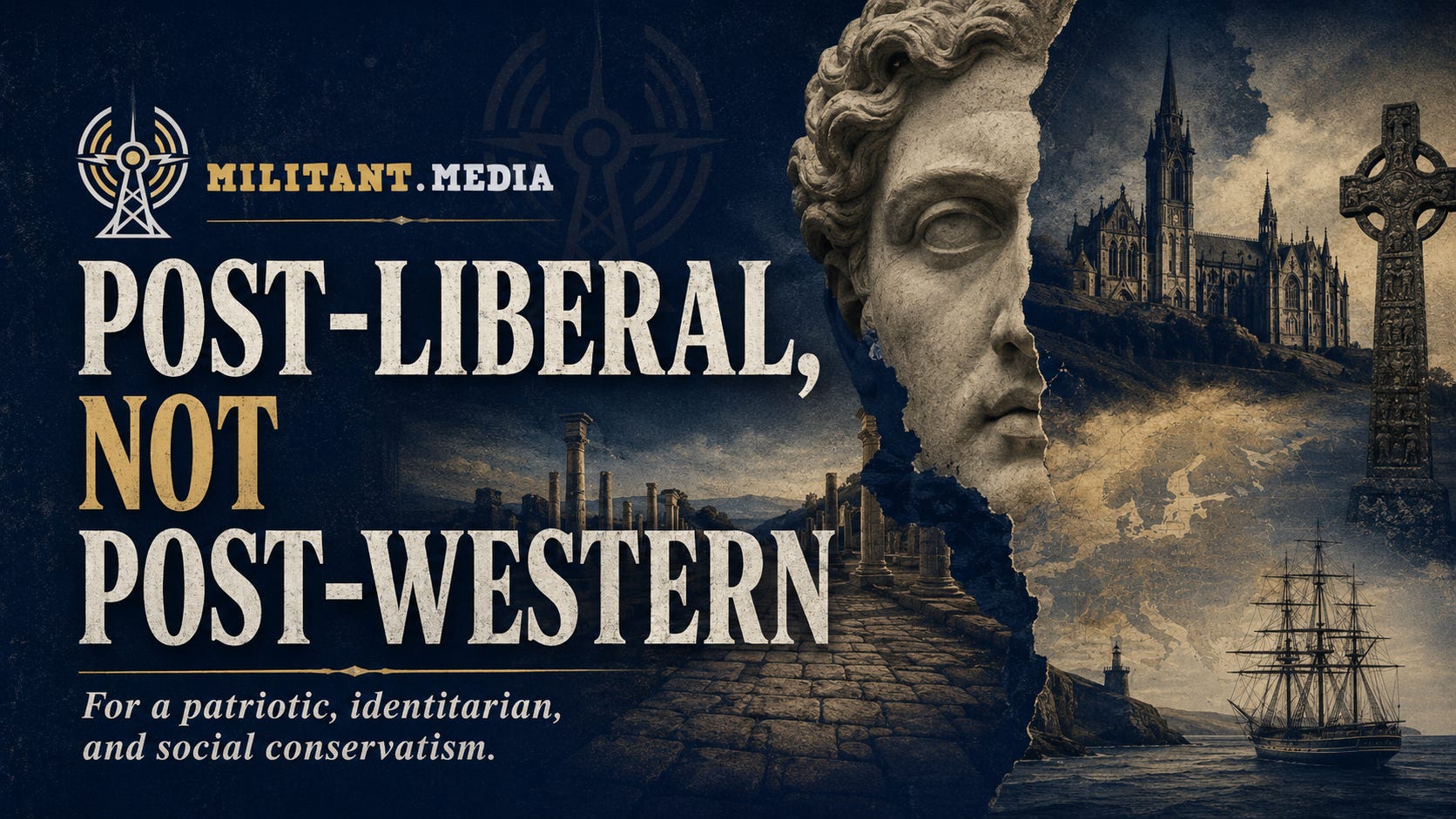
Until a few years ago, “post-liberal” was a word fit for a university seminar - perhaps one with twenty people in the room and as many different definitions of the problem. Today, much less so.
In the United States, Patrick Deneen brought the critique of liberalism out of the academic enclosure with Why Liberalism Failed and then Regime Change: Toward a Postliberal Future. First Things, one of the most influential journals of American religious conservatism, continues to debate openly what it means to move beyond liberalism; this past May, even Università Cattolica del Sacro Cuore in Milan devoted two days to the “challenges to democratic theory in the post-liberal world,” with an entire session on the critique of the liberal order and a paper by Adrian Pabst tellingly devoted to reclaiming post-liberal thought from anti-liberals. In short, this is no longer a dispute for a handful of American Catholic professors.
Not least because different sensibilities live under the same label. There is Catholic post-liberalism, there is common-good politics, there is national conservatism; on the other side of the Atlantic there are communitarian experiences that were born outside the traditional right altogether. No catechism, then. Rather, a shared unease: the sense that liberalism has ended up asking individual freedom to carry a weight it cannot bear on its own.
A society is not merely the sum of the individuals who inhabit it. A family is not a revocable contract between consumers. A nation is not a hotel where one stays only as long as the service remains satisfactory. And the market, a formidable instrument for producing wealth, becomes a rather questionable master when it also claims the right to decide which industries may disappear, which territories must empty out, how expensive it should be to have a child, and even whether a community still has the right to exist.
R. R. Reno has written that being post-liberal does not necessarily mean becoming anti-liberal: it means, first of all, ceasing to treat liberalism as sufficient to explain the whole of human and political experience. It is a distinction worth holding onto.
Because this is where a vast space opens for the right.
The old liberal conservatism fought only half the battle too many times. It defended the family and then accepted as inevitable an economic order that made building one increasingly difficult; it celebrated communities while watching entire industrial districts hollow out because somewhere an Excel spreadsheet had decided that producing ten thousand kilometers away cost a few cents less.
Something did not add up.
It is no accident that the National Conservatism Statement of Principles defends private property and free enterprise while explicitly stating that the market cannot be absolute and that economic policy must serve the general welfare, productive capacity, and independence of the nation. That is not exactly the language of 1990s free-market orthodoxy.
This is where post-liberalism becomes genuinely interesting for a patriotic, identitarian, and social conservatism. It allows us to speak again of national interest without first asking the market for permission, of work without becoming socialist, of family without confining the question to the culture war. It puts words such as belonging, authority, duty, community, and the common good back into political language - words that for too long seemed like intruders in a vocabulary dominated exclusively by the individual and his rights.
It is a road worth taking.
But there is a fork in it.
Because if liberalism does not exhaust the West, the crisis of the former cannot become the funeral of the latter.
The West, after all, was not born in a meeting room of the European Commission, nor on the banks of the Potomac. We need to go much further back.
To a dusty square in Athens, where free men argue furiously about the city and Socrates spends his time making himself unbearable by asking questions. To Rome, where a paved road disappears beyond the horizon, crossing languages and peoples, while law slowly tries to place something above brute force and citizenship eventually stretches far beyond the walls of the city that invented it.
Then that world really does collapse.
The roads empty. Aqueducts break. Cities that had once stood at the center of the world become inhabited ruins. And yet, behind the walls of some monastery, a man hunched over a sheet of parchment keeps copying words written by other men centuries before. He probably does not think he is “saving the West.” He is doing his work.
More centuries pass. Above low, dirty, noisy cities, bell towers and cathedrals begin to rise. Universities, communes, and guilds emerge; students and masters cross a continent in which languages and sovereigns change but the sense of belonging to the same civilizational space does not. Christianity gathered the Greek and Roman inheritance and transformed it, permanently altering the European way of thinking about the person, power, guilt, forgiveness, and human dignity.
The West was already all there, long before Locke.
Then came Humanism, the Enlightenment, the revolutions, liberalism. Enormous chapters in this story, some of them decisive. None large enough to tear out the pages that came before and pretend to have become the whole book.
And yet a substantial part of Western progressivism almost managed to place a copyright on the word West, making it coincide with its own particular interpretation of modernity: the individual progressively liberated from belonging, religion discreetly escorted toward the door, the global market as horizon, ever lighter borders, and rights increasingly separated - with visible irritation - from any discussion of duties.
Then part of the right began to hate all of this.
So far, so good.
The problem began when some started to hate the house in which all of that had taken up residence.
For years, progressives changed the furniture while explaining that the house belonged to them. It would be rather odd to hand them the keys as well simply because we no longer like the furniture.
Conservative post-liberalism should take the house back.
Conserving, after all, does not mean embalming the world in whichever year one happens to prefer and then organizing guided tours. A civilization turned into a museum is already dead, even if it sells a great many tickets. It means understanding what, within what we have received, still generates life and therefore deserves to be carried into the future.
Tolkien understood this better than quite a few political scientists. The Shire is precious because there is something worth crossing Mordor for - and then there must be a home to return to. The journey changes the person who makes it, the world will no longer be the same, but in the end there must still be a home waiting.
Conservatism tends the fire. It does not stand guard over the ashes.
And tending that fire also means having the courage to intervene when something is consuming the house from within. A society in which having a child becomes almost a luxury, work is no longer enough to build a family, and entire territories can be stripped of production, young people, and a future in the name of an efficiency decided elsewhere does not automatically become conservative because it leaves a little less tax to pay. Capital, markets, and enterprise are indispensable to prosperity, but they remain instruments within a national community: when they begin to devour the ends they are supposed to serve, a conservative should notice.
This is where the right can become social without being ashamed of the word, and post-liberal without becoming socialist.
The opposite danger appears when rejection of the degenerations of the contemporary West turns into fascination with the West’s rivals.
It is already happening in parts of the European and American right. Putin becomes almost a guardian of tradition because he fights Western progressivism; Xi begins to acquire an allure because China does not seem afflicted by the cultural neuroses of our elites. Other authoritarian models end up looking desirable simply because “certain things do not happen there.”
It is a mirage.
Moscow does not become Rome because it fights Brussels. Beijing does not turn into Athens because it has no wokism. The enemy of Western progressivism can perfectly well also be the enemy of the West.
One does not even need to leave the new international conservatism to understand this. The National Conservatism Statement of Principles explicitly declares itself Western and, at the same time that it challenges globalism and the transfer of sovereignty to supranational bodies, condemns the imperialism of Russia and China.
This distinction is fundamental, especially for Europe.
A post-liberal right has no reason to defend this European Union as the terminal point of the continent’s history. The Europe worth recovering is almost the opposite of the dream of a technocratic and bureaucratic superstate in which nations with centuries - sometimes millennia - of history must slowly become administrative districts of a center that claims the right to standardize their politics, culture, and even sensibilities.
The alternative, however, is not a continent reduced to twenty-seven solitudes that meet every so often for a photograph.
Europe can become stronger precisely by conceiving itself again as a confederation of sovereign nations, politically capable of acting when shared interests and a common civilization require it, without pretending that Italians, French, Poles, Hungarians, or Spaniards must gradually become a little less themselves.
After all, Europe existed when Brussels was merely a city.
It existed in pilgrims crossing frontiers long before Schengen, in medieval universities where students and masters traveled from one end of the continent to the other, in merchants’ routes, abbeys, and cathedrals whose stone and language changed but whose civilization did not. It existed even while its peoples were making war on one another, because it is perfectly possible to hate each other ferociously and still know that you belong to the same story.
This Europe comes before any treaty.
And it is precisely such an idea of the continent that also makes possible a mature Atlanticism, very different from automatic obedience to Washington.
The United States is not merely a superpower with which it is useful to maintain good relations. It is also a piece of Europe that crossed the ocean, encountered a new continent, and built something that was no longer European without ceasing to belong to the same great genealogy.
The American founding brought together English common law, republicanism, biblical culture, and European political thought. The Declaration of Independence speaks of men created equal and of unalienable rights endowed by their Creator; the Constitution and the Bill of Rights then gave institutional form to a political experiment that would profoundly shape the history of the entire West.
And then came the twentieth century.
Nations do not, of course, go to war for poetry, and the United States has always had strategic interests to defend, like everyone else. But one image is difficult to erase: twice in the first half of the century, hundreds of thousands and then millions of Americans crossed the Atlantic toward a continent from which many of their fathers and grandfathers had departed. In 1944, on the beaches of Normandy, 73,000 Americans were among roughly 160,000 Allied troops who landed on D-Day; by the end of the war, more than three million U.S. Army personnel were present in the European theater. After the rubble came the Marshall Plan and a decisive American commitment to the reconstruction of Western Europe.
Europe and America are not the same thing.
They are relatives.
And it is this civilizational kinship, even before geopolitical interests and military alliances, that gives Atlanticism its deeper meaning. Washington can be debated. Its choices can be criticized. Europe can be expected to assume responsibilities it has too comfortably delegated to the Americans for decades. But it would be peculiar to fight globalism by proclaiming the return of history and then forget the very history that binds the two shores of the Atlantic.
The knot of conservative post-liberalism lies here. Liberalism is not the terminal point of Western history and should not continue behaving as if it were. Individual liberty and the market are not enough to hold a civilization together; roots, family, duties, legitimate authority, community, work, production, national belonging, and the spiritual dimension are also necessary - the dimension a society can pretend to have outgrown only until the moment it discovers it no longer knows what it should live for.
But those political liberties, the dignity of the person, and the placing of limits on power are not the private property of contemporary liberalism either. Their roots reach much further back.
The world now arriving already seems less willing to treat the old liberal consensus as untouchable. The very fact that in 2026 post-liberalism is being discussed from American conservative journals to European universities shows, at the very least, that the question has moved beyond the margins.
For the right, this can be a great opportunity - perhaps one of the most important of the past few decades.
Provided it knows where it is going.
A patriotic, identitarian, and social conservatism does not need to go back in time, nor does it need to look for adoptive fathers among other people’s autocracies. It must take an ancient civilization, free it from the ideological encrustations of the latest season, and carry it back into a new world.