Why subscribe?
Ideas have consequences. Stay on the frequency.
Subscribe to get full access to the newsletter and publication archives.
MILITANT.MEDIA
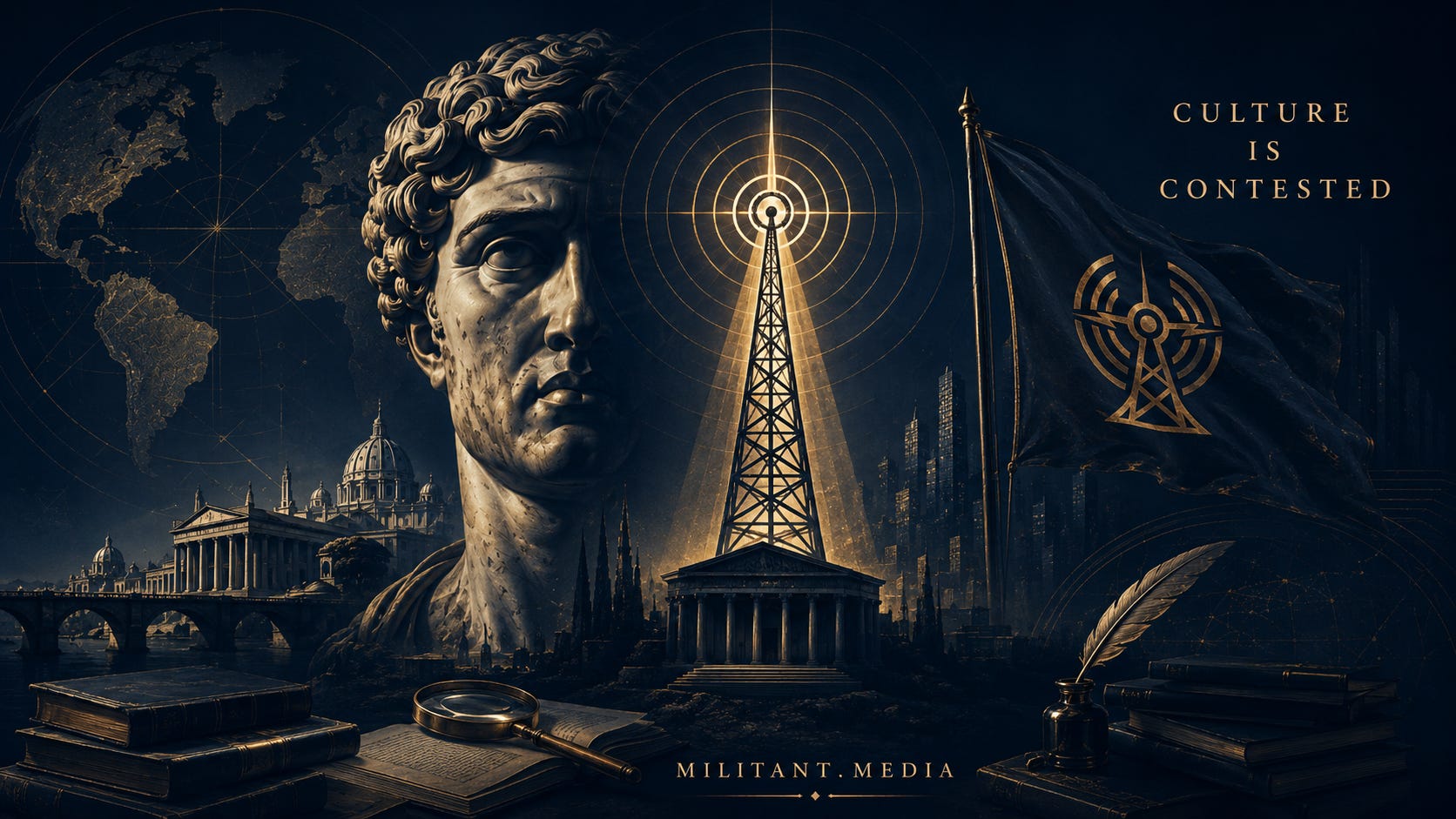
Culture is contested.
The world is becoming more polarized.
But polarization is only the visible symptom of something deeper.
An era is coming to an end.
For more than thirty years, we were told that some of history’s great questions had already been settled. That globalization was irreversible. That borders would gradually lose their importance. That economics would precede politics. That identities would become increasingly fluid. That progress followed an essentially linear path. That technology would inevitably bring societies closer together. That markets, individuals and procedures could constitute a universal language.
History seemed to have found its destination.
It did not.
The pandemic, the return of war, competition among great powers, demographic decline, migration, technological revolution, the fragility of global supply chains, the rediscovery of national interest and the re-emergence of belonging have made something increasingly clear:
history had not ended.
It has begun again.
And, as almost always happens, it began again first in the realm of ideas.
Where we stand
Militant.Media does not pretend to observe this transformation from nowhere.
We have a point of view.
We state it openly because we believe it is more honest to make visible the coordinates from which we look at the world than to conceal them behind a claim of neutrality.
Our perspective is Western.
We do not use that word merely as a synonym for geopolitical alignment, Atlanticism or relations with the United States.
The West we recognize comes from much further back.
It comes from Greece and Rome. From Christianity and law. From the idea of the person and the recognition of irreducible human dignity. From European humanism. From reason and scientific inquiry. From political liberty and the placing of limits upon power. From that profoundly Western ability to preserve a tradition while continuing to question it.
The West is a civilization before it is an alliance.
A civilization marked by errors, contradictions and conflicts, as every great human construction is, but one capable of producing an understanding of humanity, freedom, responsibility and history that we regard as part of our inheritance.
For this reason, being critical of one particular phase of the West does not mean wanting to leave the West behind.
We can question the globalized order of recent decades precisely because we intend to remain within the history of our civilization.
We are post-liberal, not post-Western.
The liberal tradition belongs to the history of the West, and many of its achievements — individual liberty, limits on power, pluralism, property rights, legal guarantees — belong to our inheritance as well.
What we consider insufficient is the transformation of liberalism into a total explanation of society.
A human community is more than a collection of individuals endowed with rights and interests.
Some bonds precede the contract.
Family, history, culture, religion, language, territory, memory, community, responsibility towards those who came before us and those who will come after us.
Markets, individuals and procedures are valuable instruments.
They are not a civilization.
Our perspective is patriotic.
Because we believe nations are not obsolete remnants destined inevitably to disappear, but historical communities through which men and women have learned to turn belonging into solidarity and freedom into a shared destiny.
The patriotism that interests us does not require hating one’s neighbour.
It requires knowing where home is.
Our perspective is identitarian.
Because a civilization that can no longer say who it is will struggle to decide where it wants to go.
Identity is not immobility.
It is not a photograph of the past.
It is the thread that allows a community to change without continually ceasing to be itself.
Our perspective is conservative.
Because some things are worth conserving.
Bonds.
Institutions.
Landscapes.
Memories.
Forms of coexistence.
Accumulated knowledge.
Limits that one generation did not invent and should perhaps understand before tearing them down.
But precisely for this reason, our conservatism can become radical — even revolutionary.
Because there comes a moment when preserving what matters means ceasing to preserve the order that is destroying it.
When uprootedness is called progress, homogenization openness, precarity flexibility, the absence of borders freedom, and the erasure of memory emancipation, defending what we have inherited can itself become an act of rebellion.
Conservative enough to know what is worth defending.
Radical enough to know that, sometimes, defending it requires changing the existing order.
Finally, our perspective is post-global.
Not because we imagine a closed world.
Not because we wish to return to autarkic economies or societies unable to communicate.
Quite the opposite.
Militant.Media is international by design.
It reads across languages, crosses borders, follows distant debates and constantly searches for ideas beyond its own national space.
But we consider the era in which globalization could be presented as a linear and irreversible destiny to be over.
The pre-Covid world imagined the progressive deterritorialization of economics, politics and even identity.
The world now emerging appears to be moving in a different direction.
More connected and, at the same time, more divided.
More technological and more identitarian.
More global in its networks and more national in its politics.
More interdependent and more conscious of its own vulnerability.
Supply chains become geopolitics.
Energy becomes sovereignty again.
Technology becomes power.
Demography becomes destiny again.
Borders become politics again.
We are post-global, not isolationist.
It is from within this contradiction that we want to observe the world that is coming.
The battles begin earlier
Major political transformations almost always come after cultural ones.
First, the words change.
Then the categories change.
Then what a society considers normal changes.
Then what it considers possible.
And finally, politics changes.
Ideas are born in universities and magazines. In think tanks and religious communities. In podcasts, films, novels, music, social networks, technology laboratories and small intellectual circles that almost nobody is watching yet.
A marginal theory can become public policy.
An American controversy can become a European conflict five years later.
A technological transformation can redefine the relationship between human beings and machines before politics has even found the language to understand it.
A new conception of the family can alter a society.
A new idea of freedom can reshape the law.
A seemingly harmless word can contain an entire anthropology.
The decisive battles often begin when almost nobody is watching.
Militant.Media exists to detect those signals.
The signal inside the noise
We live in an age of informational overproduction.
Never have we had access to so much information.
And rarely has it been so difficult to understand which of it truly matters.
Every minute produces headlines, statements, videos, controversies, outrage, reactions, counter-reactions and content designed to survive only long enough to generate more content.
Information has become almost infinite.
Attention has become scarce.
Militant.Media wants to find the signal inside that noise.
We are interested in what will remain once the controversy is over.
The authors creating new categories.
The ideas quietly crossing borders.
The cultural fractures that have not yet become elections.
The technological transformations reshaping politics before they are even perceived as political.
The questions that seem eccentric today and may become unavoidable tomorrow.
We read across national and linguistic borders.
We connect conversations that often remain separate.
We look for what deserves to be understood before it becomes obvious.
Select.
Translate.
Contextualize.
Connect.
Interpret.
And, when necessary, take a position.
Why “Militant”
The name is deliberate.
Culture is not neutral.
It never has been.
Every society is constantly deciding what to remember and what to forget.
What to teach.
What to celebrate.
What to regard as normal.
What to regard as sacred.
What to represent.
What to pass on to the next generation.
Behind every one of those decisions are ideas.
And ideas compete.
We therefore reject the fiction that cultural work becomes more serious when it hides its worldview.
We believe the opposite.
A declared position imposes a greater responsibility.
Militancy does not mean replacing analysis with slogans.
It does not mean retreating into an intellectual tribe.
It does not mean turning every fact into confirmation of what we already believed.
It means knowing where you stand when you look at the world.
It means knowing what you intend to defend.
It means having enough confidence in your convictions to submit them continually to the test of reality.
We want to read the authors with whom we agree.
But we also want to understand — perhaps above all — what is being thought by those with whom we disagree.
Because understanding an idea does not mean accepting it.
And a culture that stops understanding its adversaries has already begun to lose.
We do not claim cultural neutrality. We claim seriousness.
Why “Media”
Militant.Media is not born imprisoned by a format.
Today it may be a newsletter.
Tomorrow it may become a magazine, an observatory, an aggregator, a podcast, an archive, an audiovisual platform, an editorial laboratory — or something we have not yet imagined.
The medium is not the mission.
Militant.Media can speak in Italian while thinking in multiple languages.
It can follow an essay published in New York, a controversy born in Paris, an author from Central Europe, a Latin American cultural battle, an Asian transformation or a digital phenomenon that no longer possesses a precise geography.
Because some of the most important conversations of our time are taking place simultaneously in different parts of the world without yet realizing that they belong to the same phenomenon.
Part of our work is to connect them.
The platform may change.
The mission remains.
Follow the movement of ideas.
Identify cultural fractures before they become consensus or political conflict.
Discover authors before they become phenomena.
Understand categories before they become slogans.
Bring into our intellectual space conversations that too often arrive late, impoverished or already distorted by controversy.
Give long-form thought time to breathe inside an ecosystem designed for short attention spans.
Build a place where depth and militancy can coexist.
Identity and curiosity.
Tradition and innovation.
Belonging and intellectual openness.
The West and the world.
Who we are for
Militant.Media is for those who believe understanding their time requires something more than scrolling.
For those who work with ideas.
For those who write.
For those who communicate.
For those who study.
For those who teach.
For those who decide.
For those who want to understand before they repeat.
For those who are not afraid of having an identity and do not therefore consider it pointless to understand what exists beyond it.
For those who reject the choice between militant superficiality and academic sterility.
For those who want to encounter authors before they become famous, categories before they become slogans, transformations before they become emergencies.
For those who sense that the old order is wearing away but refuse to retreat either into nostalgia or into automatic worship of whatever comes next.
For those who regard the West as something more than a geography.
For those who believe a civilization can only be defended if it is first understood.
And for those who retain a conviction as ancient as it is radical:
ideas have consequences.
They change language.
Language changes what a society is able to think.
What a society is able to think changes what it considers possible.
And what a society considers possible eventually changes reality.
MILITANT.MEDIA
Culture is contested.
Stay on the frequency.